Fresher, smoother-looking skin on face, neck, and hands
Recovery support — look better, feel better, show up better after long days or hard work
Muscle, joint & circulation support right where you aim it — infrared reaches farther in
Relaxing warmth — near-infrared you mostly feel, not see
Everyday energy / vitality after too many indoor hours
Wind-down friendly — warm orange-red you can see, no blue
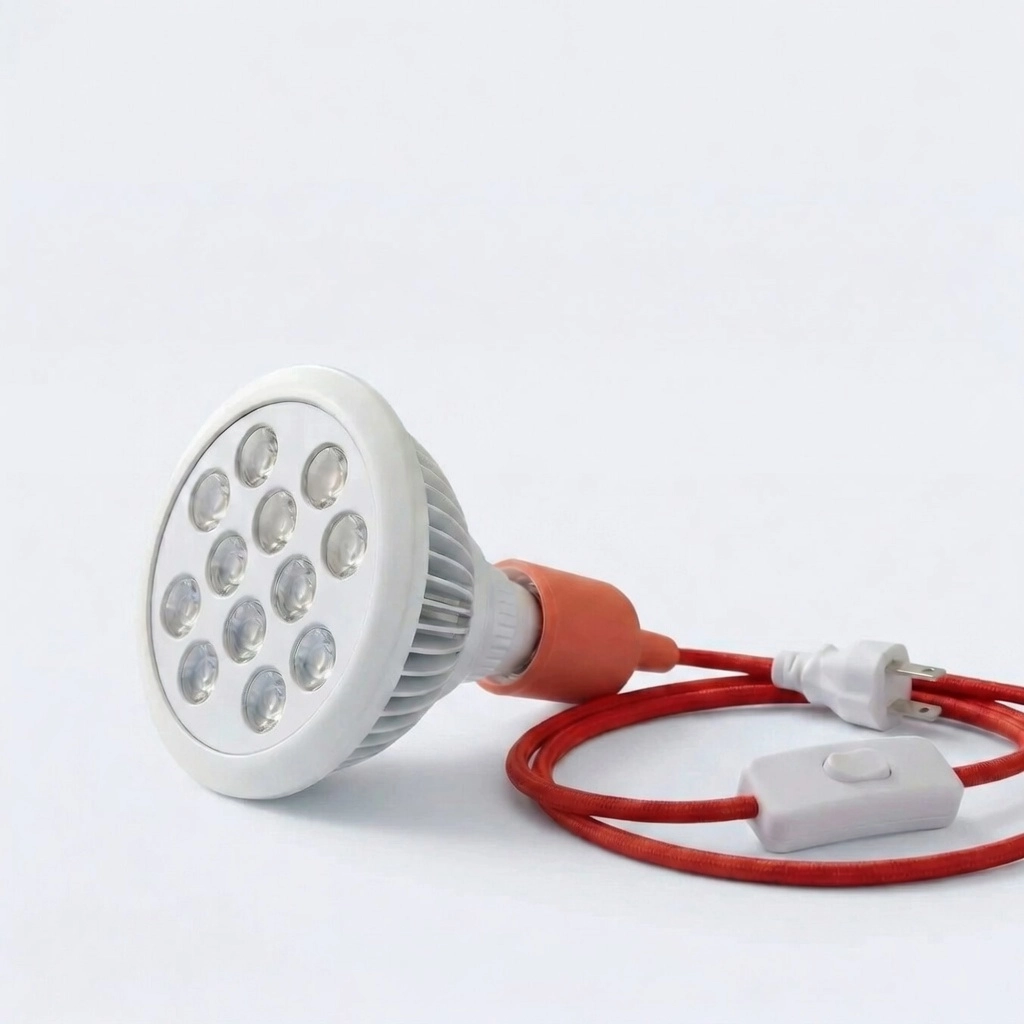
Orange, red, and near-infrared in one handheld, 620 to 830 nm: 620, 670, 760, and 830 nm. Strong up close, so sessions stay short. The light is quiet.
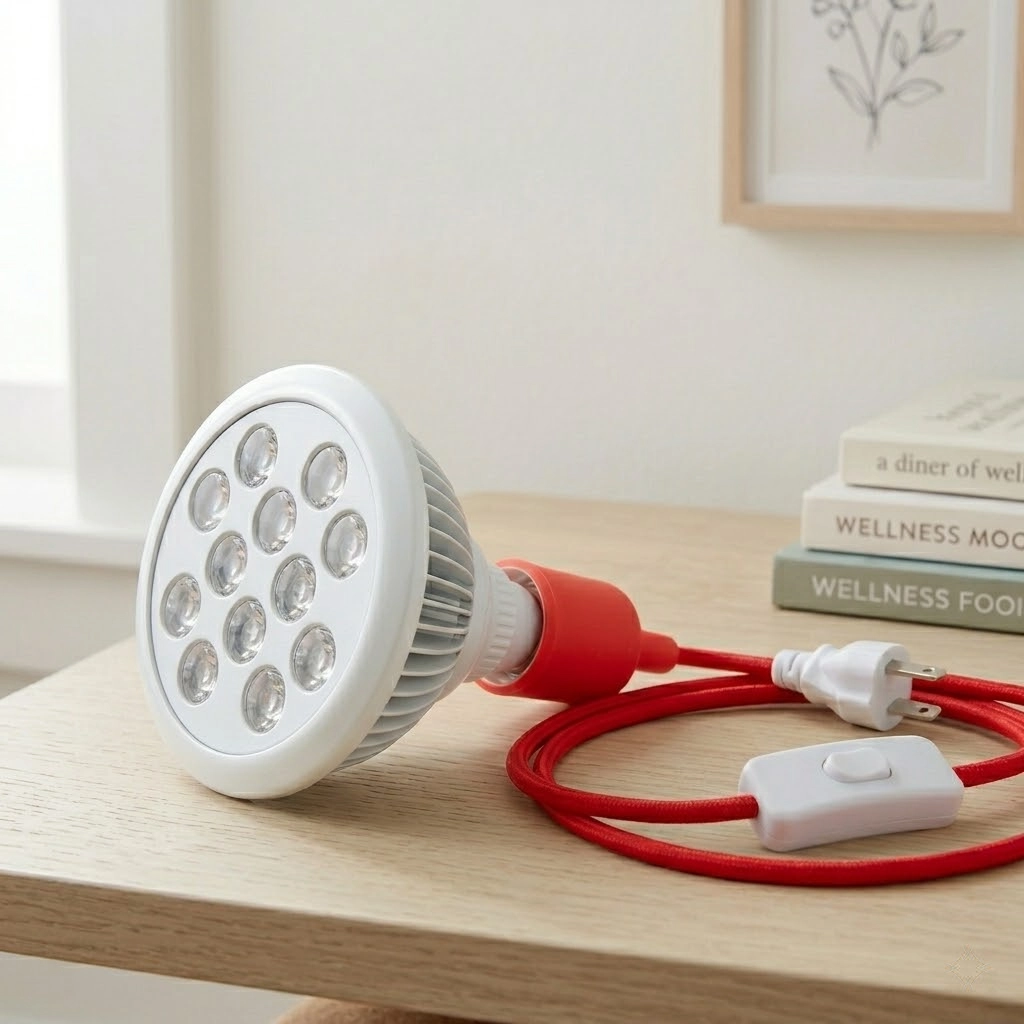
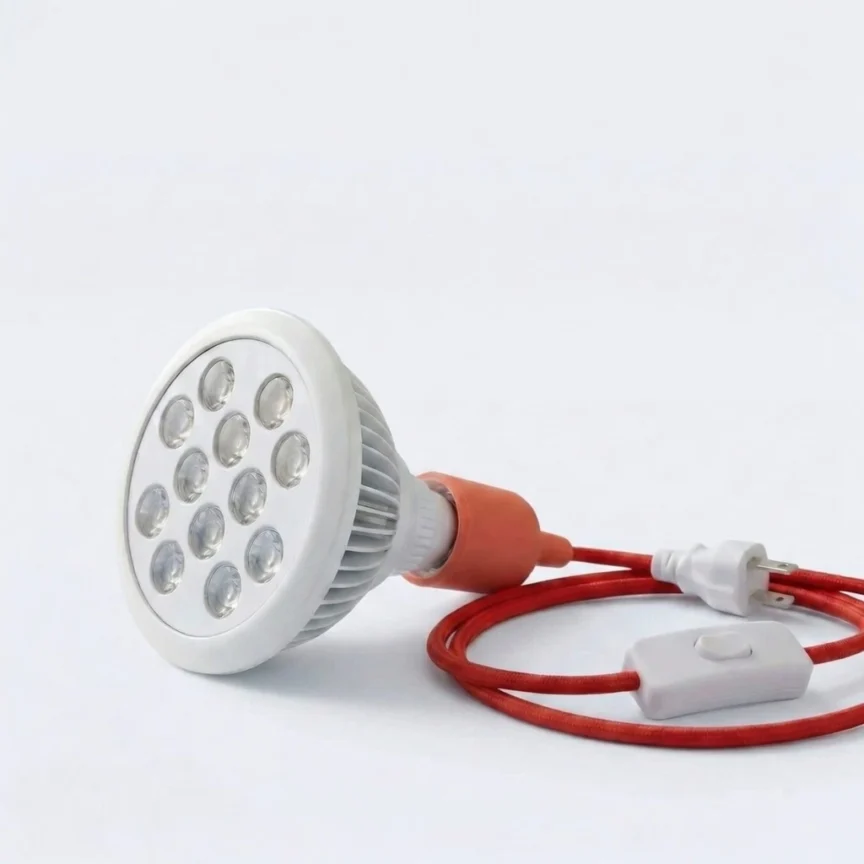
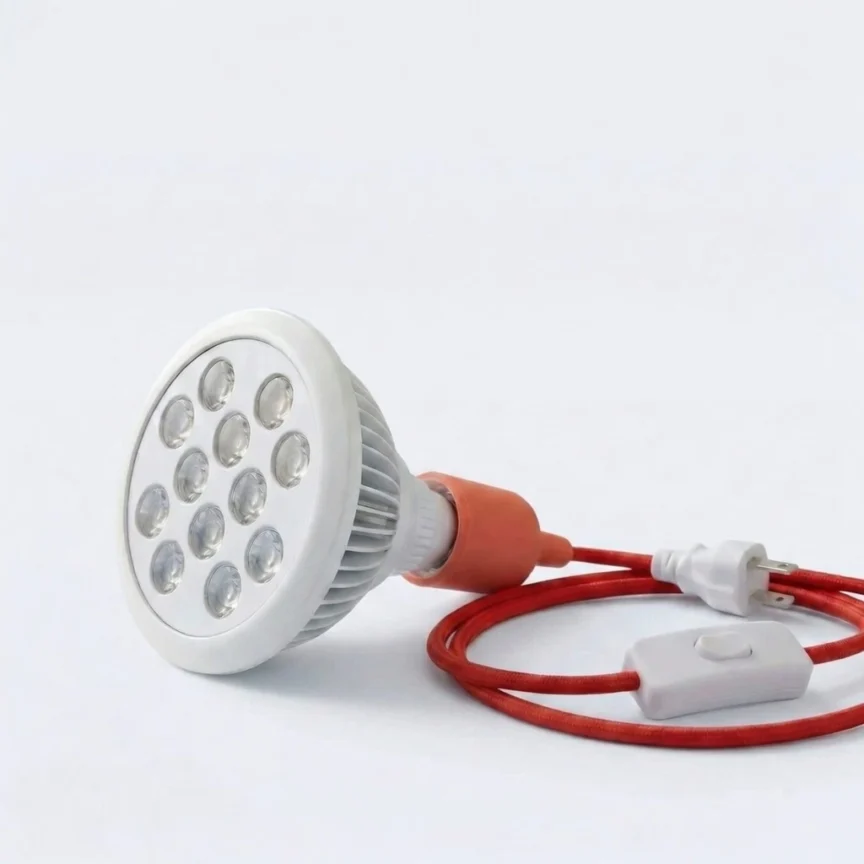
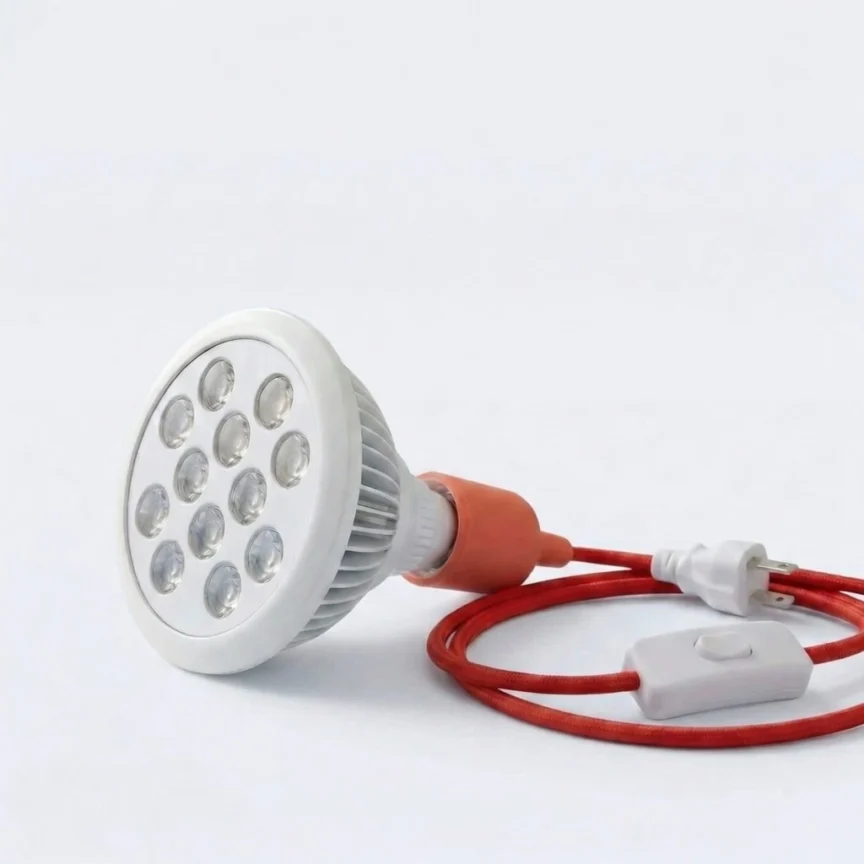
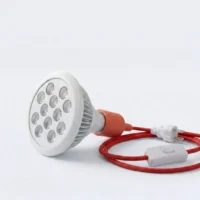
For face, neck, hands, and other spots — not a big panel. Screws into the included 6½-foot fabric cord with an on/off switch, or any lamp with a standard light bulb socket (E26/E27). Two-year warranty, 60-day no hassle returns.
Fresher, smoother-looking skin on face, neck, and hands.
Recovery support — look better, feel better, show up better after long days or hard work.
Muscle, joint & circulation support on the spots you hold it to. The infrared reaches farther in than visible light.
Relaxing warmth — the near-infrared half is felt more than seen; a gentle, relaxing warmth on the spot you’re working.
Everyday energy / vitality after hours indoors.
Evening wind-down — warm orange-red, no blue. Some screw-in handhelds add a blue LED; this one doesn’t.
Targeted sessions, anytime — runs quietly, plugs in, exactly where you need it.
Why four wavelengths (620 to 830 nm): Orange (620 nm) and deep red (670 nm) are the glow you see, working at the skin. Near-infrared (760 and 830 nm) you can’t see — you mostly feel a gentle warmth — and it reaches deeper. Each makes up a quarter of the light. One handheld instead of buying a red light and an infrared light. Four wavelengths — 620, 670, 760, and 830 nm — a quarter each, from one handheld.
As one customer put it: “After only a month, I see improvement on my complexion. I had someone tell me I look brighter and healthier.”
How it hooks up: The LGS11 has a standard E26/E27 screw base, the same as a regular light bulb. It comes with a 6½-foot fabric cord with an on/off switch and a light socket on the end. Screw the light into the socket, plug the cord into the wall, flip the switch, and hold it by the socket’s silicone grip. Want it hands-free? Screw it into any lamp or fixture with a standard light bulb socket (E26/E27, the regular US lamp socket) instead.
Worldwide voltage, so it travels — pack the cord, screw it in wherever you land.
300 mW/cm² up close, still 50 at 14 inches. 15.9 watts. Worldwide voltage. Plugs for the US/Canada/Mexico, Europe, the UK, or Australia.
Orange to infrared, one light. A quarter of the light at each of 620, 670, 760, and 830 nm. Half you see as a warm orange-red glow. Half is near-infrared you mostly feel as gentle warmth.
Use it close or from a distance. 300 mW/cm² up close for quick spot sessions; back at 34 inches it still gives 10 mW/cm² over a wider area.
Hold it or set it. In your hand on the included cord, or screwed into any standard lamp for hands-free sessions.
Customers say: “Very nice build quality and I underestimated the power it has.” Another heard from a friend that she looked “brighter and healthier.”
Setting up: Screw the LGS11 into the socket on the included fabric cord until it's snug, plug the cord into the wall, and turn it on with the on/off switch on the cord. Hold it by the socket's silicone grip. For hands-free sessions, screw it into any lamp or fixture with a standard light bulb socket (E26/E27) instead.
How to start: Hold it about 4–6 inches from the skin. Give each spot 10–20 seconds, three to five times a week. It is strong up close, so a little goes a long way.
Raising slowly: If that feels good after a week or two, add a few seconds per spot, one step at a time. Stay wherever you like the results. More is not automatically better. Moving the light farther back gives a wider, lighter dose (see the Light Density tab).
If it feels like too much: The skin gets too warm or stays flushed, you feel wired or restless, sleep gets harder after a late session, or you get a headache or feel worn out. Ease off: move the light back, shorten the time, or skip a day. Talk with your healthcare provider if you're unsure.
Practical notes:
You won't see the infrared (760 and 830 nm). The orange-red glow is only part of the light, so let warmth, not brightness, be your guide.
Close your eyes when you use it on your face, and don't look straight into the LEDs.
Unplug the cord before you screw the light in or out.
Keep the light dry. Don't cover it while it's on. Switch it off and unplug it when you're done.
6 1/2 foot fabric-wrapped power cord with on/off switch and light socket — the light screws into it
Instruction sheet
2-year warranty
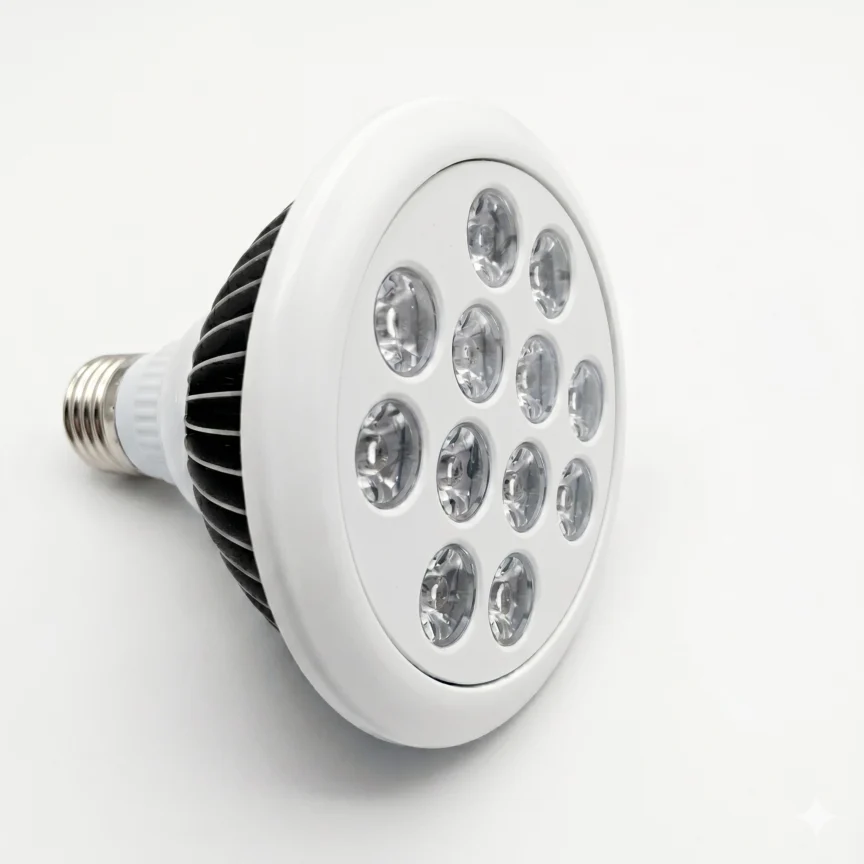
620 to 830 nm. Orange and red you can see. Near-infrared you can't — you mostly feel warmth. Each is a quarter of the light.
620 nm, orange, 3 LEDs
670 nm, deep red, 3 LEDs
760 nm, near-infrared, 3 LEDs
830 nm, near-infrared, 3 LEDs
No blue. The light draws 15.9 watts. Standard E26/E27 screw base (regular light bulb socket). Worldwide voltage.
300 mW/cm² at 0 inches
100 mW/cm² at 7 inches
50 mW/cm² at 14 inches
25 mW/cm² at 22 inches
10 mW/cm² at 34 inches
Closer is stronger, for short spot sessions. Farther is a wider, lighter dose. The light draws 15.9 watts.
How close do I hold it? Start at 4 to 6 inches. The Light Density tab shows what you get if you move in or back.
How long? Start at 10 to 20 seconds a spot, three to five times a week. Build slowly. Too warm is the sign to back off.
Why orange, red, and infrared together? Orange and red work at the skin you can see. Near-infrared reaches farther in. Having all four wavelengths, 620 to 830 nm, in one light means one handheld covers both, instead of two lights.
Why can't I see all of the light? 760 and 830 nm are near-infrared, past what the eye can see. You'll see the orange-red glow and feel warmth. The infrared is on whenever the light is on.
What do I screw it into? The included 6½-foot fabric cord. One end has a standard light bulb socket (E26/E27): screw the LGS11 in like a light bulb, then plug the cord into the wall. The cord has an on/off switch. You hold it by the socket. The light takes worldwide voltage. Pick your plug: US/Canada/Mexico, Europe, UK, or Australia. Need a second cord or a different plug? See the replacement power cord.
How do I turn it on and off? With the on/off switch on the included cord. In a lamp, use the lamp's own switch.
Can I use it hands-free? Yes. Screw it into any lamp or fixture with a standard light bulb socket (E26/E27, the regular US lamp socket) and point it where you want it.
Can I use it on my face? Yes — close your eyes and don't look straight into the LEDs.
How is the LGS11 different from the LGS1? The LGS1 is orange and red only (610, 630, 670 nm). The LGS11 adds two near-infrared wavelengths and is stronger up close (300 vs 150 mW/cm² at 0 inches).
And from the LGS8 or LGS17? The LGS8 is infrared only (760, 830 nm). The LGS17 is red and infrared at 660 and 850 nm. The LGS11 is the one with orange, red, and infrared together.
How is this different from a panel? This is the small one, for a spot. For more of you at once, see the PL11 pod light or BL11 body light — same four wavelengths.
Does it get hot or make noise? It's quiet. You'll feel gentle warmth on the skin up close — that's normal. If a spot gets too warm, move back or stop.
What if it isn't for me? Two-year warranty and 60-day no hassle returns.
Do I need goggles? Goggles are optional as long as you don't look directly into the light. Close your eyes when you use it on your face. Half the light is near-infrared you can't see, so it's stronger than it looks.
Orange, red, and near-infrared light from 620 to 830 nm is studied in labs and trials for skin appearance, recovery, circulation where the light lands, sleep-friendly evenings without blue, and cellular energy.
Fresher, smoother-looking skin
Red plus 830 nm infrared, split-face trialLee et al. (2007). Journal of Photochemistry and Photobiology B, 88(1), 51–67. 76 adults had half the face lit twice a week for four weeks with 830 nm, 633 nm, both together, or a sham light. The lit sides showed smoother-looking skin and better elasticity readings, with more collagen and elastic fibers in skin samples.
Red and red-to-infrared lightWunsch & Matuschka (2014). Photomedicine and Laser Surgery, 32(2), 93–100. In a controlled trial of 136 volunteers, twice-weekly sessions (611–650 nm or 570–850 nm) improved complexion, skin feel, and ultrasound-measured collagen density compared with controls.
Recovery support after hard work
Red and infrared around exerciseLeal-Junior et al. (2015). Lasers in Medical Science, 30(2), 925–939. A meta-analysis of trials using red and near-infrared light before exercise found better performance and better markers of exercise recovery than placebo.
Muscle, joint & circulation support where aimed — and why infrared reaches farther
670, 740, and 830 nm and blood vesselsKeszler et al. (2018). Archives of Biochemistry and Biophysics, 649, 47–52. Red and near-infrared light widened blood vessels in a lab model, strongest at 670 nm, with 740 and 830 nm also working. The light released nitric oxide, a natural vessel-relaxing signal.
Longer wavelengths go deeperAsh et al. (2017). Lasers in Medical Science, 32(8), 1909–1918. Skin-model calculations show penetration depth rises with wavelength — the reason the 760 and 830 nm LEDs reach farther in than the visible orange and red.
Tissue comfort signaling (review)Hamblin (2017). AIMS Biophysics, 4(3), 337–361. Reviews how red and near-infrared light influence the signals behind tissue comfort.
Wind-down friendly — no blue
Blue is the strong melatonin suppressorBrainard et al. (2001). Journal of Neuroscience, 21(16), 6405–6412. Short-wavelength blue light suppresses melatonin most; longer, warmer wavelengths do far less.
Red light and evening melatoninHo Mien et al. (2014). PLOS ONE, 9(5), e96532. Red light near 631 nm did not suppress melatonin in that protocol.
Everyday energy (cellular energy)
Four bands, four LEDsKaru & Kolyakov (2005). Photomedicine and Laser Surgery, 23(4), 355–361. Cell action spectra peak in four bands: about 614–624, 668–684, 751–772, and 813–846 nm. The LGS11's 620, 670, 760, and 830 nm each sit inside one.
The same peaks in living cellsKaru et al. (2005). Journal of Photochemistry and Photobiology B, 81(2), 98–106. Cell layers absorbed at 616, 665, 760, 813, and 830 nm, and 830 nm light shifted cytochrome oxidase — the enzyme at the cell's last energy step.
670 and 830 led the packWong-Riley et al. (2005). Journal of Biological Chemistry, 280(6), 4761–4771. Of five red and infrared wavelengths tested on cells, 670 and 830 nm did the most to restore cytochrome oxidase activity and ATP, the cell's energy currency.
620 and 760 work through the same enzymeKao et al. (2023). Journal of Photochemistry and Photobiology B, 241, 112681. Both 620 nm and 760 nm changed cell activity, and the effect needed cytochrome oxidase.
In customers' words
“After only a month, I see improvement on my complexion. I had someone tell me I look brighter and healthier.” — Laura S.
“I find I’m sleeping a bit better and obviously my energy has improved.” — JP
Bioenergetic view: A metabolism that keeps up makes everyday energy easier to come by. Orange, red, and near-infrared light is one way people support that bioenergetic picture: cellular energy at cytochrome oxidase, from the skin you see to the tissue a little deeper. People use it for everyday energy, skin that looks more awake, recovery, and an easier evening.
Note: These papers study wavelengths and mechanisms. None of them used this exact LGS11 handheld at its session protocol. Individual experiences vary. This information is for educational purposes only and is not intended to diagnose, treat, cure, or prevent any disease.
Not a medical device. Do not use it to treat a condition.
Close your eyes when using it on your face, and do not look straight into the light. Near-infrared is invisible, so the light is stronger than it looks.
Do not use it on broken skin, or if the skin is already hot or burned. Stop if a spot gets uncomfortably warm.
Talk with your healthcare provider before use if you are pregnant, sensitive to light, or take medication that makes you sensitive to light.
Unplug the cord before screwing the light in or out. Keep away from water and from children. Do not cover it while it is on. Unplug it when you are done.
*These statements have not been evaluated by the Food and Drug Administration. This product is not intended to diagnose, treat, cure, or prevent any disease.
Get fresher, smoother-looking skin, recovery support, and relaxing near-infrared warmth on the spots you aim at, with orange, red, and near-infrared in one light.
Muscle, joint, and circulation support, with infrared that reaches farther in. Everyday energy after indoor days. Warm orange-red for evening wind-down, no blue. Four wavelengths, 620, 670, 760, and 830 nm, a quarter each, at 300 mW/cm² up close: seconds a spot. Hold it on the included 6½-foot fabric cord with its on/off switch, or screw it into any standard lamp (E26/E27) hands-free. Quiet, worldwide voltage. As customers put it: "it seemed like the best overall light with some of all the different types of light," and "Very nice build quality and I underestimated the power it has."
Family-owned shop, real answers when you have a question. Two-year warranty. 60-day no hassle returns.
I have used this treatment device on the head, eyes, thyroid, etc. , but at this point in time I feel it is most effective for heel ligament disorders.
Thu Nov 09 2023 06:39:43 GMT+0000 (Coordinated Universal Time)
After only a month, I see improvement on my complexion. I had someone tell me I look brighter and healthier. It seems to have reduced the wrinkles around my eyes. The switch though is tempermental. Often I must lightly toggle it to keep it on. The light is worth the $$ though. I hope one day I can afford a larger unit.
Tue Feb 22 2022 02:45:07 GMT+0000 (Coordinated Universal Time)
I started the red light therapy for inflammation and it's working as expected. I'm also interested to see the other benefits received from my treatments. The only thing that I have an issue in doing my self therapy treatments is that it takes a while and I can't get to every part of my body.
Tue Oct 12 2021 04:22:37 GMT+0000 (Coordinated Universal Time)
I got this mainly for discomfort in my hip and I think it's helping. I also use it in other areas just to get the restorative effects of the light. Great company and fast shipping. I chose this one because it seemed like the best overall light with some of all the different types of light.
There was no indication on website or product about the power (mW/cm2) so correct time (dosage) can be determined. I receive a quick response when I emailed the question. The answer was given along with explanation (that I had researched and found on the internet) that the solar power readings used by most red light therapy companies may not be accurate to determine Joules. I appreciated the explanation, this companies own research.
Their lights do have the standard mW/cm2 that all reputable companies use.
I use the handheld light at 12 inch distance for 20 minutes. A single session calms nerve damage in my foot, and daily use the past 3 weeks has reduced the pain to barely noticeable even with 3 mile walks 5 times a week.
I am pleased with my first red light and will eventually buy a large panel.
Grateful to this company's service, price and fast shipping.
Tue Mar 23 2021 01:46:17 GMT+0000 (Coordinated Universal Time)
Still feels too soon to tell (one month in), but I find I’m sleeping a bit better and obviously my energy has improved. It may have helped with my skin irritation a bit too. So far I think this is a great buy.
Thu Dec 24 2020 01:08:30 GMT+0000 (Coordinated Universal Time)
Using this light at the recommendation of my myofascial release therapist. She was able to release a muscle insertion that has been tight for 10 years!