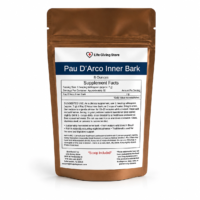
Digestive comfort and healthy immune function in a warm, naturally sweet cup of tea.
- Digestive comfort. One customer says it "helps my tum-tum feel good-good."
- Healthy immune function. Pau d'arco has been brewed for generations in South America for exactly this.
- It tastes good. "Outside of cinnamon, this is the best tasting bark around. The tea tastes very much like vanilla and has a warming effect."
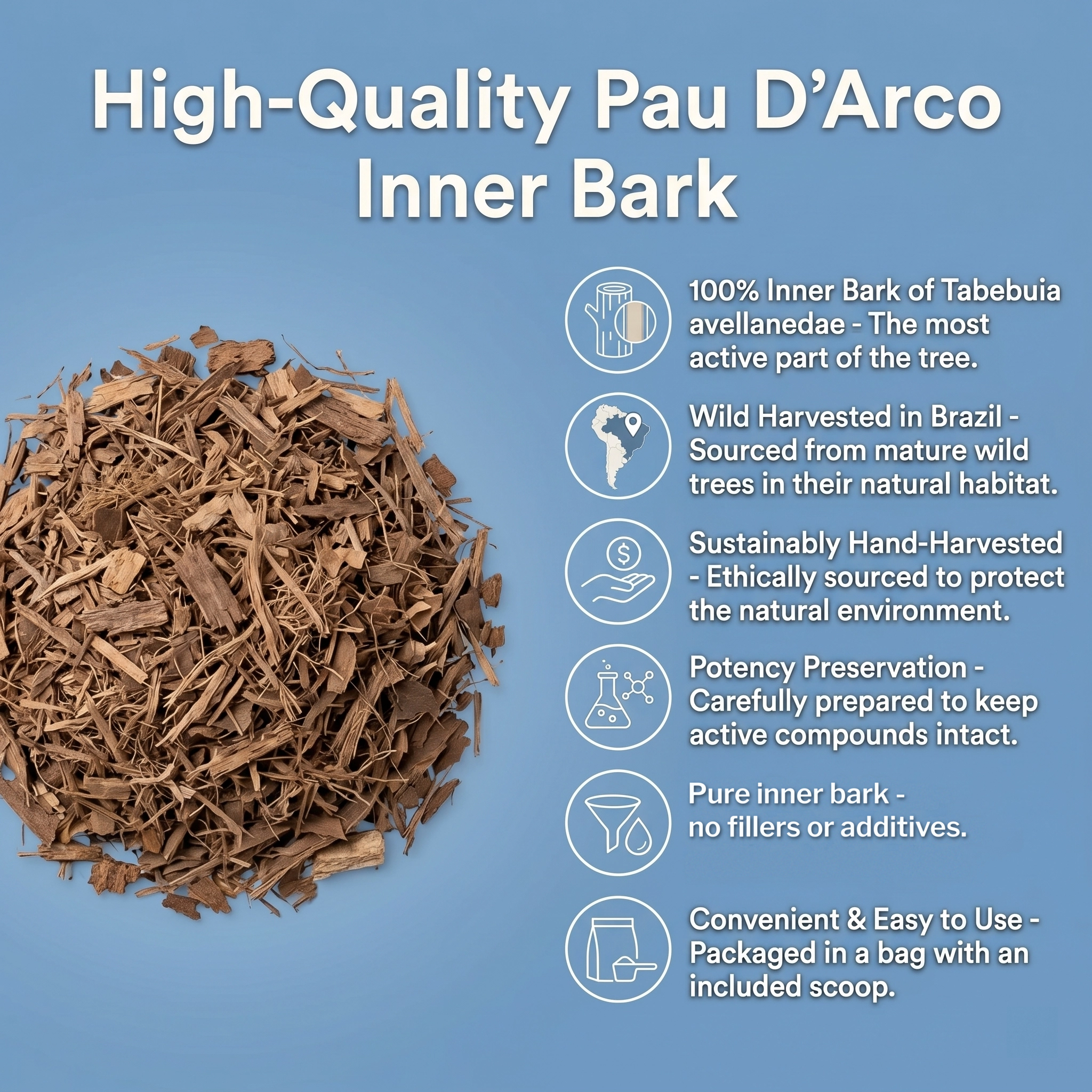
- Inner bark only. We use only the inner bark of Tabebuia avellanedae, where its naphthoquinones, lapachol and beta-lapachone, are concentrated.
- Wild and sustainable. Hand-harvested from mature wild trees in their natural habitat in Brazil.
Why it fits bioenergetic, low-toxin living. Wild trees mean no farm sprays. One ingredient, nothing added. Its naphthoquinones belong to the same family of quinones as vitamin K and coenzyme Q10, which take part in cellular energy.
See the Certificate of Analysis (PDF) in Quality & Sourcing.
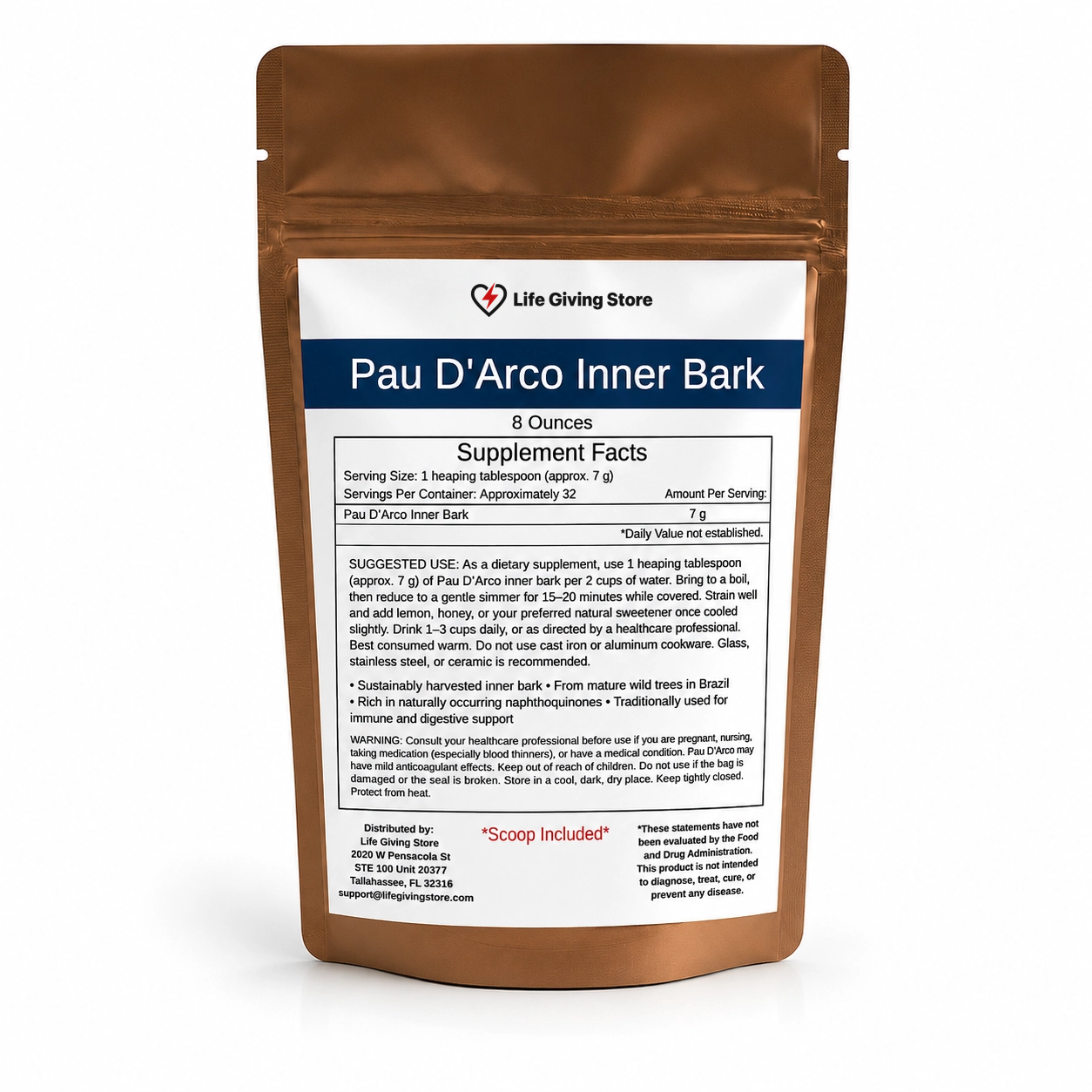
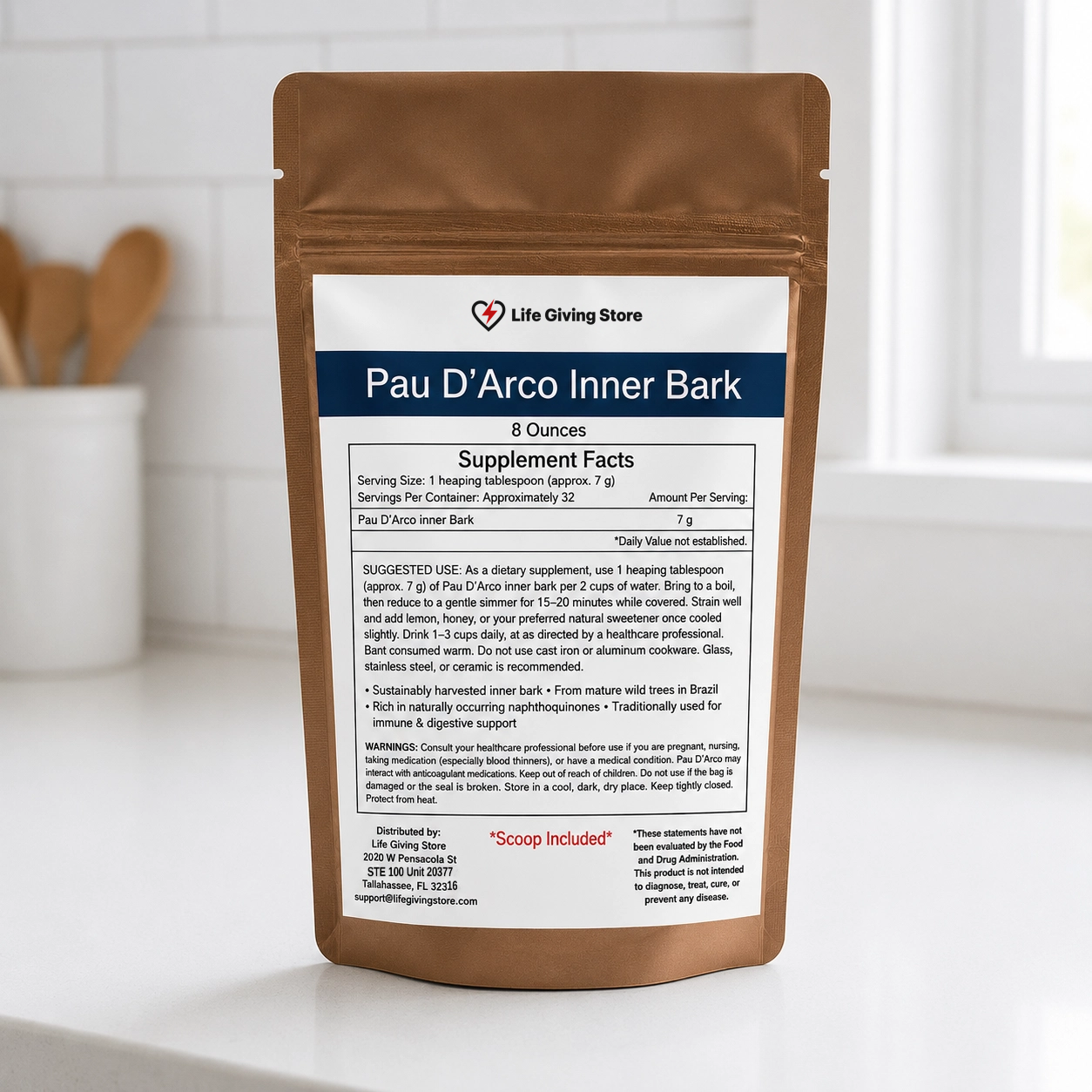
After a long search for a source that stands out, this is the one we chose. 8 oz bag with scoop, about 32 servings. 60-day no hassle returns.
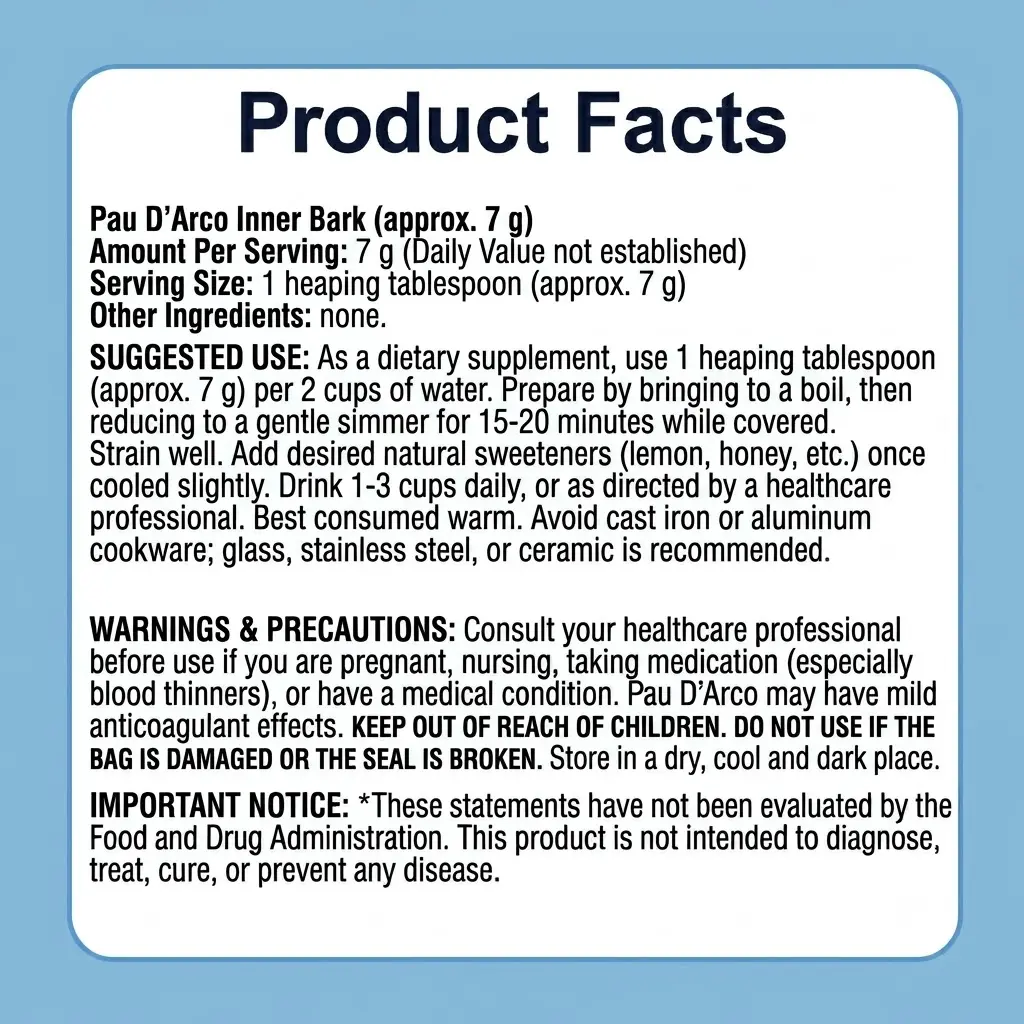
How to brew: use 1 heaping tablespoon (about 7 g) per 2 cups of water. Bring to a boil, then cover and simmer gently for 15–20 minutes. Strain well (muslin or a fine strainer). Add lemon or honey once it cools a little.
Start low: 1 cup a day.
Raise slowly: if it suits you, go up to 2–3 cups a day, or as directed by your healthcare professional.
If it feels like too much (an unsettled stomach), go back to 1 cup or brew it weaker.
Use glass, stainless steel or ceramic, not cast iron or aluminum. Talk with your provider first if you take blood thinners.
Pure Pau D'Arco Inner Bark (Tabebuia avellanedae)
Other Ingredients: None
100% Pau D'Arco • Origin: Brazil
Pau d'arco (Tabebuia avellanedae, also called T. impetiginosa or taheebo) inner bark contains naphthoquinones such as lapachol and beta-lapachone, plus other plant compounds.
A broad review
Zhang J, Hunto ST, Yang Y, et al. (2020). Tabebuia impetiginosa: A Comprehensive Review on Traditional Uses, Phytochemistry, and Immunopharmacological Properties. Molecules 25(18):4294. PMID 32962180. Traditional uses, compounds, and studies on the immune system.
A traditional remedy that went global
Gómez Castellanos JR, Prieto JM, Heinrich M (2009). Red Lapacho (Tabebuia impetiginosa)--a global ethnopharmacological commodity? J Ethnopharmacol 121(1):1-13. PMID 18992801.
Antioxidant activity
Park BS, Lee KG, Shibamoto T, et al. (2003). Antioxidant activity and characterization of volatile constituents of Taheebo (Tabebuia impetiginosa Martius ex DC). J Agric Food Chem 51(1):295-300. PMID 12502424.
What's in the bark
Warashina T, Nagatani Y, Noro T (2004). Constituents from the bark of Tabebuia impetiginosa. Phytochemistry 65(13):2003-11. PMID 15280007.
Warashina T, Nagatani Y, Noro T (2005). Further constituents from the bark of Tabebuia impetiginosa. Phytochemistry 66(5):589-97. PMID 15721952.
Bioenergetic & low-toxin perspective
Ray Peat wrote about the quinone family that lapachol belongs to.
"By the time coenzyme Q 10 , ubiquinone, was officially discovered, Koch had moved to Brazil to continue his work with the biological effects of the quinones, including the anthraquinone compound of brazilwood, which is used as a dye." — Ray Peat (https://raypeat.com/articles/articles/cascara-energy-cancer-fda-laxative-abuse.shtml)
In the same article he notes that Koch "also used a naphthoquine, lapachon," the pau d'arco compound, and that vitamin K, another naphthoquinone, takes part in the mitochondrial energy system.
A related study, not one Peat cited: Zhang 2020 (above).
Note: These studies are about pau d'arco in general, not this exact product. This information is for educational purposes only and is not intended to diagnose, treat, cure, or prevent any disease.
Consult your healthcare professional before use if you are pregnant, nursing, taking medication (especially blood thinners), or have a medical condition. Pau D'Arco may have mild anticoagulant effects. Keep out of reach of children. Do not use if the bag is damaged or the seal is broken.
Store in a cool, dark, dry place. Keep tightly closed. Protect from heat.
*Statements made on this website have not been evaluated by the Food and Drug Administration. This product is not intended to diagnose, treat, cure, or prevent any disease.
Digestive comfort and immune support in a tea customers call "the best tasting bark around."
- Inner bark only, from mature wild trees in Brazil.
- Sustainably hand-harvested, no fillers or additives.
- "Excellent quality bulk Pau D'arco and excellent customer service."
- About 32 cups per bag, scoop included.
- A family-owned shop for bioenergetic, low-toxin living.
- 60-day no hassle returns.